Independent product project
Simplifying everyday business work
KarobarKit is a portfolio project demonstrating product decisions, analytical thinking and delivery. It is not a validated business; no customer interviews, adoption or revenue are claimed.
The problem hypothesis
A freelancer preparing a quotation, invoice and receipt may repeat the same details across tools. I chose this connected task as a focused entry point into a much broader toolkit. This audience choice is a hypothesis, not a research finding.
Choosing simplicity over more features
The owner found the growing application too complicated for small businesses and freelancers. A review of the live interface found competing entry points, overlapping directory filters, and portfolio planning tools inside the customer workspace. This is an owner-led usability finding, not customer research.
I prioritised six everyday tasks, removed the goal-guide detour, separated portfolio planning, and simplified explicit draft saving. Existing specialist tools remain available through More tools. Forms now start without demo identities, examples cannot be exported, and result breakdowns show the adjustments behind the total.
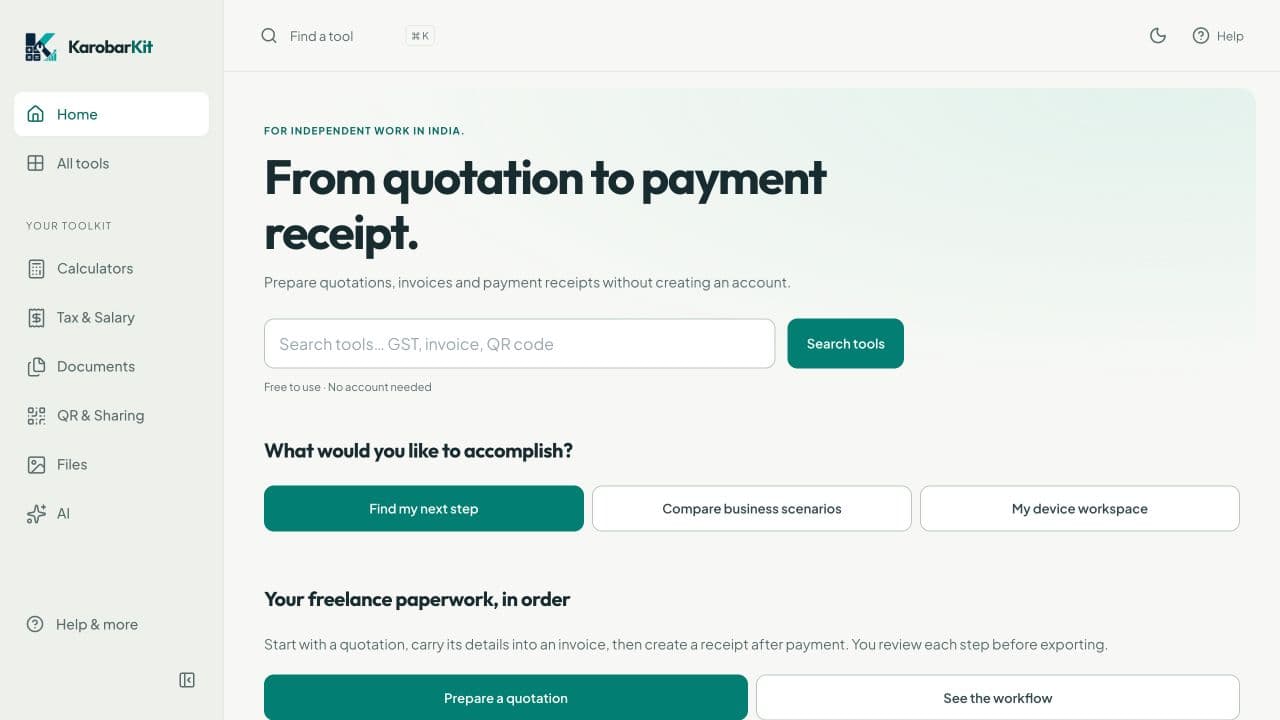
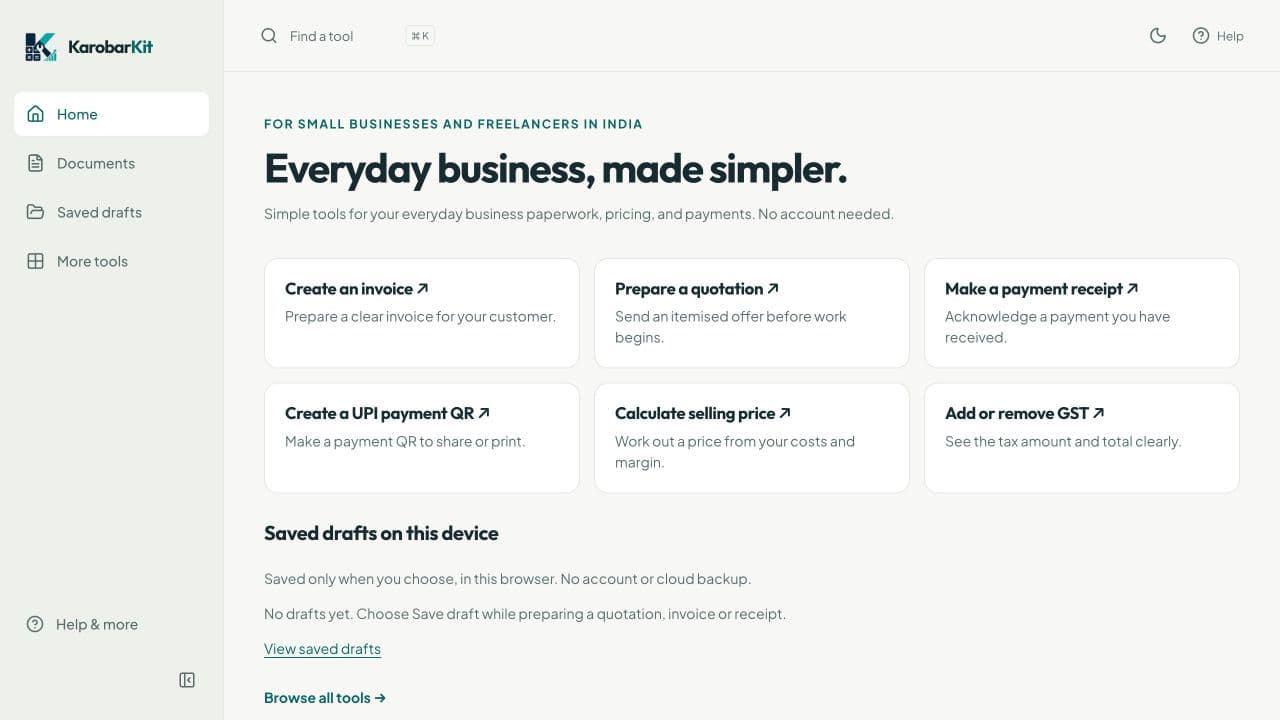
Accounts, payment tracking, reminders, CRM, inventory and more AI were deferred. The release is evaluated through workflow, export and storage checks. No improvement in customer conversion, retention or revenue is claimed.
My role and implementation approach
Product Owner — Independent Project. The project covers positioning, scope, prioritization, acceptance criteria and release decisions. AI coding tools assisted implementation, documentation and automated testing. This work demonstrates delivery and tradeoff reasoning; it does not substitute for customer research or cross-functional team experience.
Decisions and tradeoffs
- Keep the toolkit accessible without mandatory accounts to reduce entry friction; accept that documents are not a permanent cloud archive.
- Use explicit, temporary local handoffs rather than placing client details in URLs; accept an extra review/import step.
- Keep numeric results deterministic; use AI only for optional drafting, never as the authority for tax arithmetic.
- Defer cloud accounts and paid acquisition; offer explicit device-local saving as a design hypothesis. For this portfolio, invest in a coherent workflow, reproducible analysis and clear evidence instead.
Issues found through actual verification
An owner question about an unexplained ₹6,400 exposed a breakdown that hid the cess row. Live workflow tests then found stale example expiry dates and an invalid no-discount transfer. Those issues were fixed and regression coverage added. These are owner/test observations, not interview findings.
Verification covers quotation → invoice → receipt with explicit imports and three PDF exports at desktop and mobile viewport sizes. Automated checks verify calculation contracts, safe analytics properties, session handling and verification-traffic exclusion. Viewport simulation is not testing on every physical phone.
Explore the experiment planner and prioritization board
Explore a product funnel
Simulated data only. Every session and timing below is invented. These are analytical examples, not real users, experiments, traction or measured improvements.
- Started sessions
- 12
- Valid results
- 9
- Exporting sessions
- 6
- Completion rate
- 50.0%
- Median start-to-export
- 92.5 seconds
In this sample, 3 sessions stop before a result and 3 stop between result and export. The next investigation would inspect those steps; these counts alone cannot explain why people left.
Each session counts once per stage. Export requires an earlier start and result. Completion is exporting sessions divided by started sessions; median time includes exporting sessions only, so it excludes abandonments. An export is a proxy for value, not proof of a useful document.
Modeled B changes assumed export counts and timings. It demonstrates sensitivity to assumptions, not a causal effect or statistically significant uplift. Channel counts are too small and nonrandom for ranking acquisition quality.
Download SQL analysisWhat I can conclude
The workflow is implemented and has passed the documented automated checks. The analytical example demonstrates metric definitions, session deduplication, sequencing, channel segmentation and assumption testing. It cannot establish real completion rates, retention, commercial demand or product-market fit.
What would change the roadmap?
Optional local business details and drafts now address repeated re-entry; their effect on retention remains unvalidated. If discovery is the bottleneck, onboarding would take priority. Without that evidence, neither a paid tier nor more features is justified. Production custom events remain disabled because the current Vercel plan does not support them.